zondag 26 juni 2011

From colonial policing to community policing in Bahrain: the historical persistence of sectarianism

This paper focuses on the history of policing in the Kingdom of Bahrain, a small Arab, Muslim country. The historical discourse about Bahraini policing, though scant, has not adequately confronted the role the police have had in protecting Sunni hegemony in majority Shiah majority nation, a residual feature of colonialism. Through colonial records, press accounts, and Bahraini historical sources, the importance of sectarian politics in the development of Bahraini policing emerges. By drawing on conflict criminology and paying attention to the relevant cultural processes, a new approach to understanding policing in Bahrain, and the Gulf region, emerges. The analysis suggests that although Bahrain police force has liberalized in recent years by developing a community policing unit, disapproval and unrest by Bahraini Shiah remains a significant social and political problem.

By Staci Strobl
John Jay College of Criminal Justice, New York
International Journal of Comparative and Applied Criminal Justice, Vol 35, No. 1, February 2011, pp 19-37
zaterdag 25 juni 2011

Voices in Parliament, Debates in Majalis, and Banners on Streets: Avenues of Political Participation in Bahrain (paper)

This paper tries to analyze political participation in Bahrain in its diverse forms, in formal and informal spheres and those in between. It aims to delineate these entanglements by at first presenting the structural setting of Bahraini politics, describing the limitations to formal political participation set by the authoritarian state. Then the institutions in their varying degrees of formality will be identified in which political actors pursue their aims. In a next step focuses on three exemplary groups of actors that due to their different toward the formal state institutions have developed divergent strategies and use different loci. It will be shown how Bahraini political actors are caught up in various blockages. Their strategic options are currently defined by their positions toward parliament. While actors within parliament can participate in legislation to a certain degree, those outside cannot influence any details. Those can, however, participate in agenda setting: The wider they incorporate less formal political arenas into their strategies, the more influential they become. Some strategies that appear to be directed towards exerting pressure on the government to achieve certain policy outcomes, however, aim at different ends: oppositional groups are caught in infighting, hereby losing sight of influencing the government altogether. Moreover, the fragmentation of Bahrain's society and the high level of distrust between the various political, religious and ethnic groups constrain political actors even further.

By Katja Niethammer
European University Institute
Robert Schuman Centre for Advanced Studies

donderdag 16 juni 2011

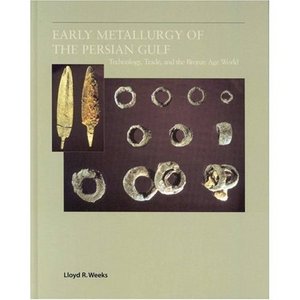
Early Metallurgy of the Persian Gulf: Technology, Trade, and the Bronze Age World


This volume examines the earliest production and exchange of copper and its alloys in the Persian Gulf, a major metal supply route for the Bronze Age societies of Western Asia. Weeks addresses the geological and technological background to copper production in southeastern Arabia and contextualizes evidence for major fluctuations in prehistoric copper production. The core of the volume contists of compositional and isotopic analyses. The relationship between specialized copper production, exchange, and the development of social complexity in early Arabia is examined, and the author addresses the broader archaeological issue of the Bronze Age tin trade, which linked vast areas of Western Asia, from the Indo-Iranian borderlands to the Aegean, in the third millennium BC.

Unexceptional: America's Empire in the Persian Gulf, 1941-2007

Unexceptional examines U.S. policy vis-^-vis the Persian Gulf since the Second World War. It asserts that the American experience in this strategic yet volatile region known for its plentiful oil and gas can be best understood as an unexceptional imperial endeavor similar in kind to that of the British and Ottoman empires of previous eras. If you want to know more about this exceptional book, please read this post written by the author at Harvard Law School blogs.


If for any reason the link to download this interesting book fails, please let me know, I'll upload it in a new link.

woensdag 15 juni 2011

Propaganda, the Press and Conflict: The Gulf War and Kosovo


An incisive analysis of the use of the press for propaganda purposes during conflicts, using the first Gulf War and the intervention in Kosovo as case studies.

As the contemporary analysis of propaganda during conflict has tended to focus considerably upon visual and instant media coverage, this book redresses the imbalance and contributes to the growing discourse on the role of the press in modern warfare.

Through an innovative comparative analysis of press treatment of the two conflicts it reveals the existence of five consistent propaganda themes: portrayal of the leader figure, portrayal of the enemy, military threat, threat to international stability and technological warfare. As these themes construct a fluid model for the analysis and understanding of propaganda content in the press during conflicts involving British forces, they also provide the background against which the author can discuss general issues regarding propaganda. Amongst the issues which have become increasingly relevant to both recent academic debate and popular culture, the author tackles the role of the journalist in war coverage, the place of the press in a news market dominated by 'instant' visual media and the effectiveness of propaganda in specific cultural and political context.

The book demonstrates the existence of five propaganda themes that are consistently produced to justify armed intervention by the British government. The book utilizes the British press to demonstrate the existence of these themes and the argument is strengthened through a comparative analysis of both five newspapers and two conflicts. In addition, the book discusses general issues regarding propaganda which have become increasingly relevant to both recent academic debate and popular culture. The manuscript also tackles the role of the journalist in war coverage and the place for the written press in a news market dominated by 'instant', visual media.

The Arabian Frontier of the British Raj: Merchants, Rulers, and the British in the Nineteenth-Century Gulf


The Arabian Frontier of the British Raj is a study of one of the most forbidding frontier zones of Britain's Indian Empire. The Gulf Residency, responsible for Britain's relationship with Eastern Arabia and Southern Persia, was part of an extensive network of political residencies that surrounded and protected British India. Based on extensive archival research in both the Gulf and Britain, this book examines how Britain's Political Resident in the Gulf and his very small cadre of British officers maintained the Pax Britannica on the waters of the Gulf, protected British interests throughout the region, and managed political relations with the dozens of Arab rulers and governors on both shores of the Gulf.

James Onley looks at the secret to the Gulf Residency's effectiveness--the extent to which the British worked within the indigenous political systems of the Gulf. He examines the way in which Arab rulers in need of protection collaborated with the Resident to maintain the Pax Britannica, while influential men from affluent Arab, Persian, and Indian merchant families served as the Resident's "native agents" (compradors) in over half of the political posts within the Gulf Residency. Very long substantial chapters on Bahrain.

Economic Co-Operation in the Arab Gulf: Issues in the Economies of the Arab Gulf Co-Operation Council States


With global concerns over rising oil prices, this book examines the major issues facing the economies of the Arab Gulf today, covering all six of the Arab Gulf Cooperation Council (AGCC) states: Bahrain, Kuwait, Oman, Qatar, Saudi Arabia and the United Arab Emirates.
Providing a detailed account of the central features of the economies of the Arab Gulf, this book draws out the critical trends that will shape the region in future years. It includes an in-depth analysis of topical issues such as the AGCC monetary union, intra-AGCC national labour movement, Islamic banking and programmes to finance small and medium-sized enterprises (SMEs). The book:
* assesses the costs and benefits of the proposed monetary union, assessing whether AGCC economic structures have converged sufficiently, and whether these economies have the internal flexibility necessary to make the union work effectively
* investigates intra-national labour mobility in the context of the forthcoming monetary union and identifies the most crucial features in a successful common AGCC employment strategy
* considers the fortunes of the prominent Islamic banks in the region
* examines the impact on liquidity of the external economic environment and regulatory policy
* contrasts and compares some of the major SME financing schemes, focusing in particular on SME financing in Oman.

Badr El Din A. Ibrahim currently serves as an Economic Expert at the Ministry of Finance, Oman. He was previously Assistant Professor and Head of the Department of Economics at Khartoum University, and thereafter Professor of Economics at the Modern College of Business and Science, Oman. He has written on SMEs, Islamic banking, adjustment programmes, & AGCC economies. He is the author of Banking and Finance to Small and Micro-enterprises in Sudan - Some Lessons from the Islamic Financing System (Institute of Islamic Banking and Insurance, London, 2004).